الصبّار
Not native, not wild, and not planted for its fruit. It was planted as a wall. The walls are still standing in places where there is nothing left to enclose.
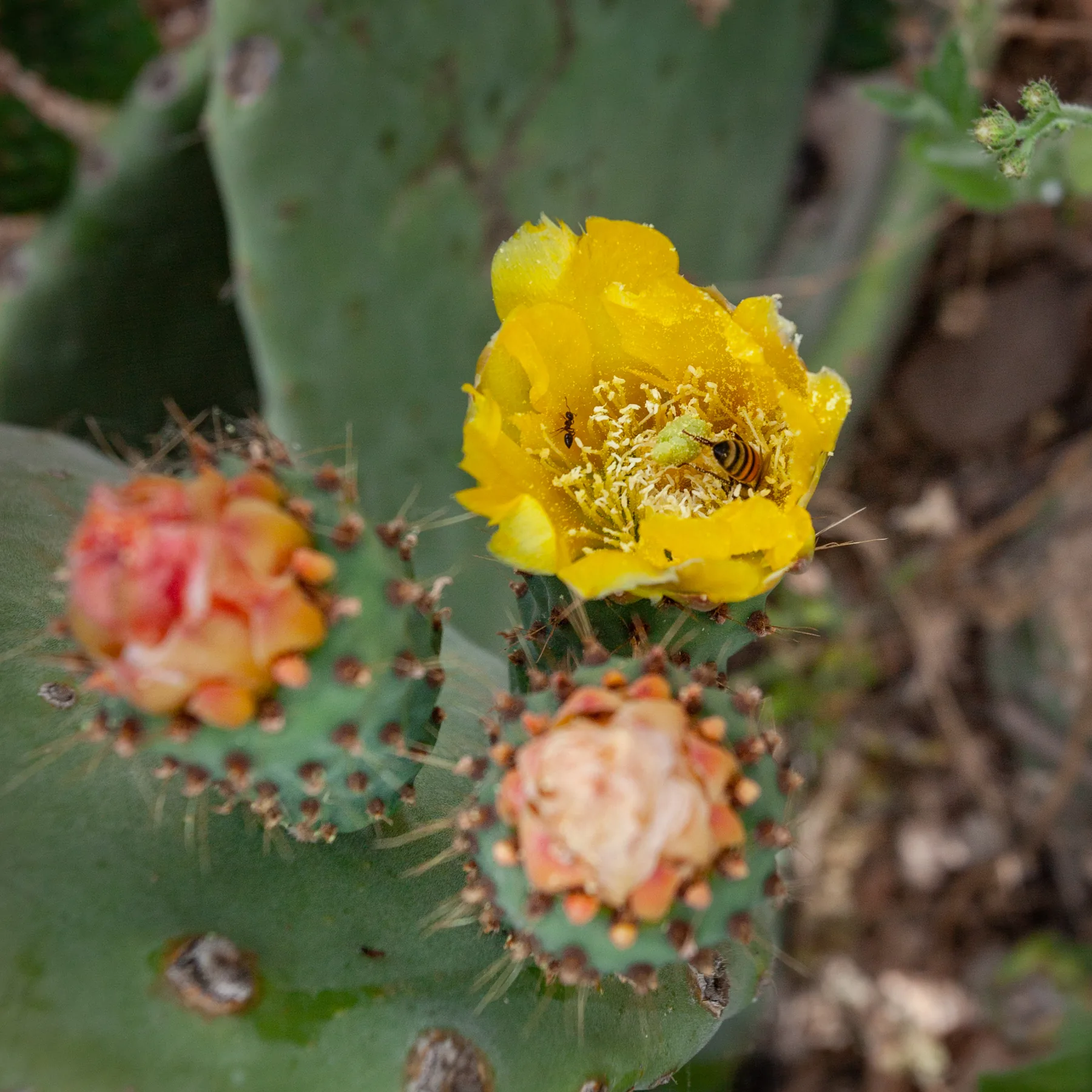
Updated · 7 registers · 9 sources cited
Register 01What it is called
الصبّار — sabbar, and in spoken Palestinian also sabr. The fruit is صبرة, sabra, or التين الشوكي, at-tin ash-shawki: the thorny fig.
The name is doing two things at once. صبر, the same three letters, is the Arabic word for patience: endurance held over time, the virtue of continuing. Palestinian writers treat this as the plant's central fact rather than a pun. The magazine Raseef22 describes the overlap between sabr as a state of continued endurance and the plant Palestinians call sabir as what fixes the cactus so firmly in Palestinian cultural space (رصيف22).
Everyday phrases carry it further — صبر أيوب, the patience of Job; إن الله مع الصابرين, God is with the patient, and both readings are available at once: the quiet one that waits out affliction, and the active one in which staying put is the resistance.
A plant that names a virtue is unusual. A plant that names the specific virtue a dispossessed people are told to practise, while itself refusing to be uprooted, is something else.
And this reading is not new. In 1928 the Palestinian physician and ethnographer Tawfiq Canaan published a forty-page study of Palestinian plant lore, which includes a short table of what plants mean when they appear in a dream. Quince means a parting; carob means ruin; vine means recovery. Against the prickly pear he records: patience — success which requires prolonged effort, from sabr, the verb to wait (Canaan, JPOS 8, 1928, p. 163; more on Canaan).
Canaan also sets down the story behind it. The prophet al-Khadr, who drinks only from the water of life, once emptied what was left in his goblet over a plant growing nearby. It happened to be a prickly pear. Ever since, Canaan writes, this plant has remained ever green and indestructible.
Twenty years before the Nakba, a Palestinian scientist wrote down that this plant means patience, and that it cannot be destroyed. Then the villages were destroyed, and the plant was what remained to mark them.
Register 02Where it grows, and why it is here
The prickly pear is not a Palestinian native. It is Mexican. It reached the Mediterranean after the Spanish invasion of the Americas and arrived in Palestine roughly four centuries ago (رصيف22).
It was not brought for its fruit. It was brought because it makes an excellent wall. Palestinians planted it in dense lines around houses, yards and fields — a barrier between the household and the open country that kept livestock in and animals and intruders out. It needs no water, no maintenance and no mortar; it repairs itself; and a pad knocked to the ground simply roots where it falls.
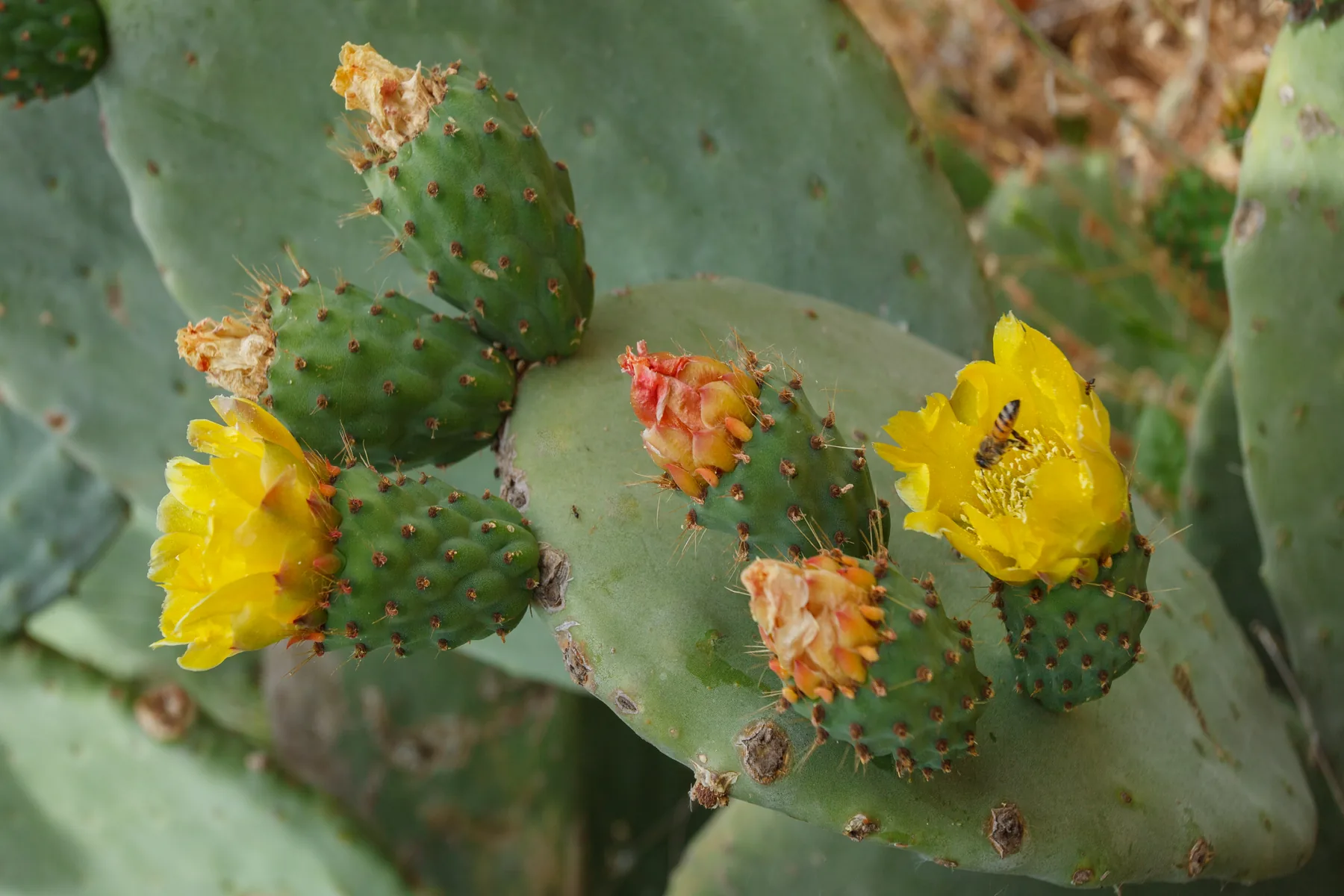
That combination, no upkeep required, and almost impossible to remove, is why this register matters more than it looks. The cactus was chosen as boundary infrastructure by people who intended to stay. It then outlasted their staying.
Register 03At the table
The fruit ripens in the hardest weeks of the year, through the height of summer, which is part of its meaning: the sweetest thing available arrives at the worst moment, and only to whoever is willing to handle it.
Sabr is picked and peeled early, while the night's damp still holds down the glochids — the near-invisible hairs that are far worse than the visible spines. The Palestinian seasonal food tradition treats it as a summer fixture and a national one, sold from carts and stalls, peeled to order, eaten cold (مركز معاً).
Register 04In the culture
The Palestinian folk song al-Sabr, documented from Latifa Sam'an and sung by Amal Murkus, puts the plant, the virtue and the expulsion into four lines:
الصبر يا مبتلي والصبر يا أيوب
والصبر جبتو معي حتى ينمحي المكتوب
والصبر جبتو معي من يوم هجرتنا
وحجارة الدار تبكي فرقتنا
Patience, O afflicted one; patience, O Job. I carried patience with me until what is written is undone. I carried patience with me from the day they drove us out, and the stones of the house weep for our parting (رصيف22).
In Palestinian painting the cactus does the same work, and one artist in particular fixed it there. Asim Abu Shaqra (1961–1990), from Umm al-Fahm, painted the sabr over and over, but lifted out of the ground and standing in a household pot: rooted plant, made portable, made displaced. He said of it that the cactus fascinated him by its astonishing ability to flower in the middle of a thorny death. He was twenty-nine when he died.
The line continues. Rana Bishara, from Tarshiha, sliced cactus pads and sealed them in the glass jars normally used for pickling vegetables, under the title From so much patience, our patience has become pickled (2012). Fouad Agbaria, from Musmus, paints cactus being lifted out of the earth by a toy digger. Ahmad Yasin, from Nablus, paints directly onto living pads and says he does not want a picture that ends up in a museum, because the museum is the land (رصيف22).
Register 05The living map
Here is what the hedges became.
More than 500 Palestinian villages were destroyed and depopulated in 1948. Houses were dynamited or bulldozed; in many places the ruins were afterwards planted over with pine forest. What could not be removed was the cactus. It has no single stem to cut, no taproot to pull, and every fragment left in the ground grows back.
So the hedges stayed where they were planted, marking out the perimeters of houses and plots that no longer exist. The Palestinian refugee-rights organisation BADIL puts it plainly: the cactus indicates the presence of a Palestinian village, and was generally used to divide agricultural space and mark ownership, and it is still there, in spite of the demolition and the continuous settlement built on top of the ruins of those villages (بديل — جريدة حق العودة).
Raseef22 gives the same fact its sharpest form: the outer walls of cactus turned into a witness to the Nakba, and its pads into headstones over the demolished houses — pointing to where each one stood, and testifying that it had been there (رصيف22).
A survey map can be redrawn. A place name can be changed on a signpost. A hedge that will not die keeps the floor plan.
This is not a metaphor Palestinians reached for after the fact. It is a research method. Fieldwork by the Al-Wah'at Collective, published in The Avery Review, describes cactus hedges retracing the erased boundaries of villages destroyed in 1948, and notes that where cactus thrives in a forest or an empty field, a village once stood. It also cites the Palestinian historian Shukri Arraf, whose Land, Human and Labor documents residents of Faqqu'a planting cactus hedges after 1948 (Areej Ashhab, Gabriella Demczuk and Ailo Ribas, The Avery Review).
Register 06Taken
In Hebrew the plant is tsabar, and the same word is the standard term for a Jewish Israeli born in the country: thorny outside, sweet inside. The image was built out deliberately — the cartoon everyman Srulik in the 1950s, the talking cactus puppet Kishkashta on children's television from 1976, and outward as a national brand, from the hummus company Sabra to Marvel's Israeli superheroine of the same name, introduced in 1980 as an agent of the Mossad (رصيف22).
Writing in BADIL's journal Haq al-Awda, Tal Dor, an Israeli researcher of Israeli society, sets out what that appropriation accomplishes. The cactus became part of the "Israeli" landscape and so a natural symbol to most Israelis; the daily encounter with it raises no question about the existence of Arab life in Palestine. Her conclusion is the load-bearing one: the everyday sight of the cactus does not raise such questions. It erases them (بديل — جريدة حق العودة).
That is the specific mechanism worth naming. The hedges are evidence, standing in plain sight, of the villages destroyed in 1948. Renaming the plant after the people who destroyed them converts the evidence into scenery.
Register 07Photographed before
The American Colony Photo Department in Jerusalem photographed the prickly pear twice over, in the two modes this record keeps returning to. First as a specimen: a single fruiting pad cut and propped against a draped cloth on a table, lit and shot as an object.
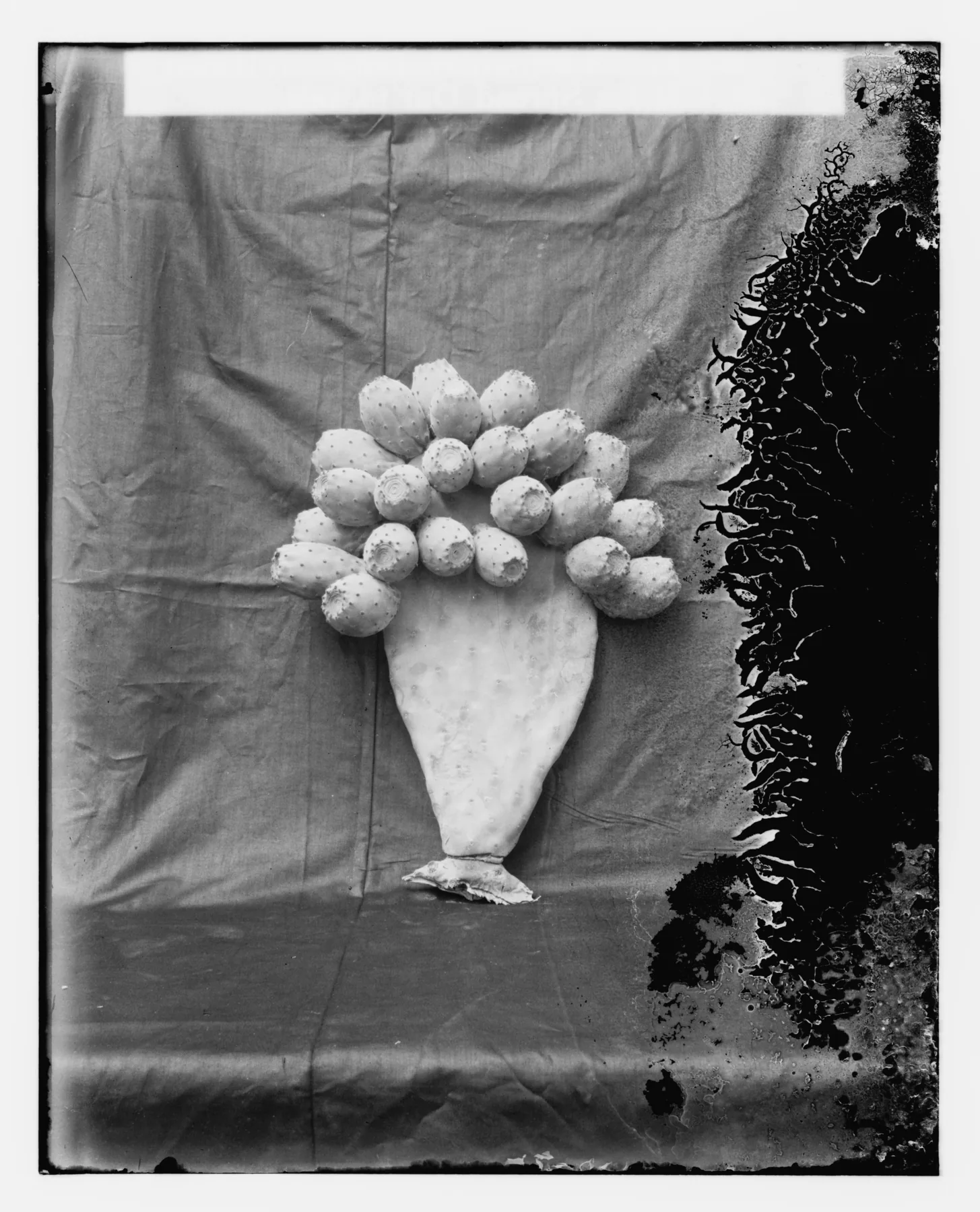
Library of Congress, Matson Collection, matpc.11651 · public domain
And then in the field. This is a stereograph plate captioned “Jaffa to Jerusalem. Cactus hedges and the Tower of Ramleh,” dated about 1900 — a track running between prickly-pear hedges taller than a camel, with a rider, a man and a donkey on the road, and the tower of the White Mosque standing up out of the trees behind.
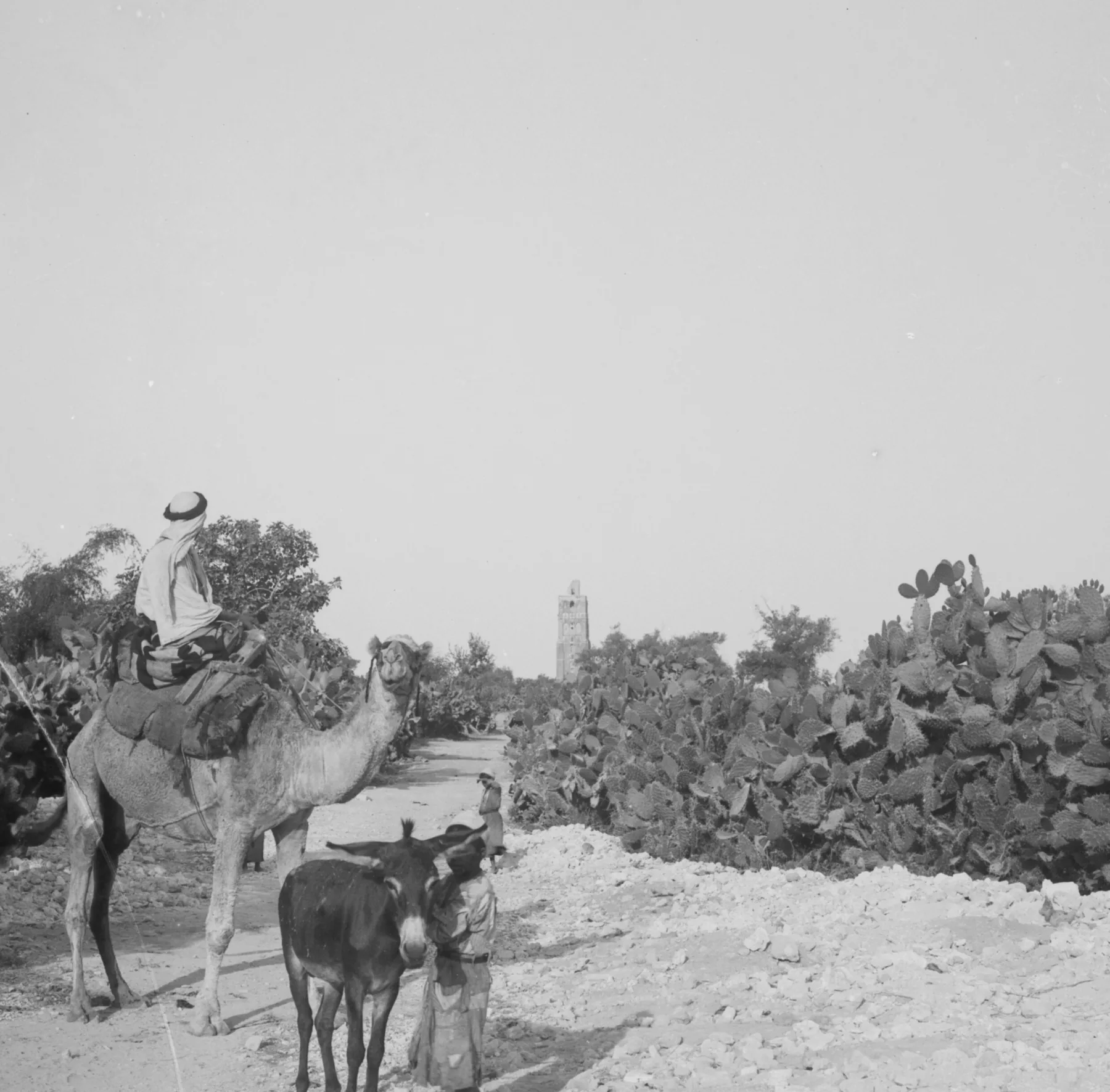
Library of Congress, Matson Collection, matpc.00835 · public domain · one half of a stereograph pair
The photographer's subject was the road and the tower. The hedges were incidental — walls, the way walls are, holding the edges of somebody's plot.
al-Ramla — الرملة — had a Palestinian population of 17,590 and was occupied on 12 July 1948 (Zochrot). On that same day, according to the Institute for Palestine Studies' encyclopedia of the Palestine question, the decision was taken to expel the entire population of Ramla and neighbouring Lydda; Yitzhak Rabin, commanding Operation Dani, signed the order that the inhabitants "must be expelled quickly, without regard to age." The following day roughly 70,000 people were given half an hour to leave and were driven on foot toward Ramallah. Hundreds died on the road of thirst and exhaustion (palquest, Interactive Encyclopedia of the Palestine Question).
The camel is gone. The rider is gone. The town's people were driven out of the frame in a single afternoon fifty years after the shutter opened. The hedges are the only thing in the photograph with a reasonable chance of still being alive.
This is what the archive keeps doing on this site. The American Colony photographers were assembling a picturesque Holy Land for a Western market, and what they left behind is a dated, located, public-domain record of Palestinian villages before they were emptied — including the plant that is still standing where the houses were.
Sources
- الصبر والصبّار في الهوية الفلسطينية... وتغلغل "التسابار" الإسرائيلي — لؤي وتد ونور قربي، رصيف22، 14 يونيو 2024
- نبات الصبار يدرك ما لا يدركه الصهاينة — تال دور، جريدة حق العودة العدد 36 · بديل، المركز الفلسطيني لمصادر حقوق المواطنة واللاجئين
- صَبْر — “Patience” as Resistance — Areej Ashhab, Gabriella Demczuk and Ailo Ribas (Al-Wah'at Collective), The Avery Review 69
- الطعام التراثي الموسمي الفلسطيني: الصبر (الصبار) — مركز معاً للتنمية
- T. Canaan, “Plant-lore in Palestinian Superstition,” The Journal of the Palestine Oriental Society 8 (1928): 129–168 — the dream table and the al-Khadr legend; read at source
- al-Ramla — village profile (population 1948, occupation date) — Zochrot
- Lydda, 9–13 July 1948: a city-wide massacre culminating in the death march — palquest, Interactive Encyclopedia of the Palestine Question · Institute for Palestine Studies
- “Prickly pear (Opuntia ficus-indica, Haw.)” — American Colony Photo Department · Library of Congress, Matson Collection, matpc.11651
- “Jaffa to Jerusalem. Cactus hedges and the Tower of Ramleh” — American Colony Photo Department, c. 1900 · Library of Congress, Matson Collection, matpc.00835